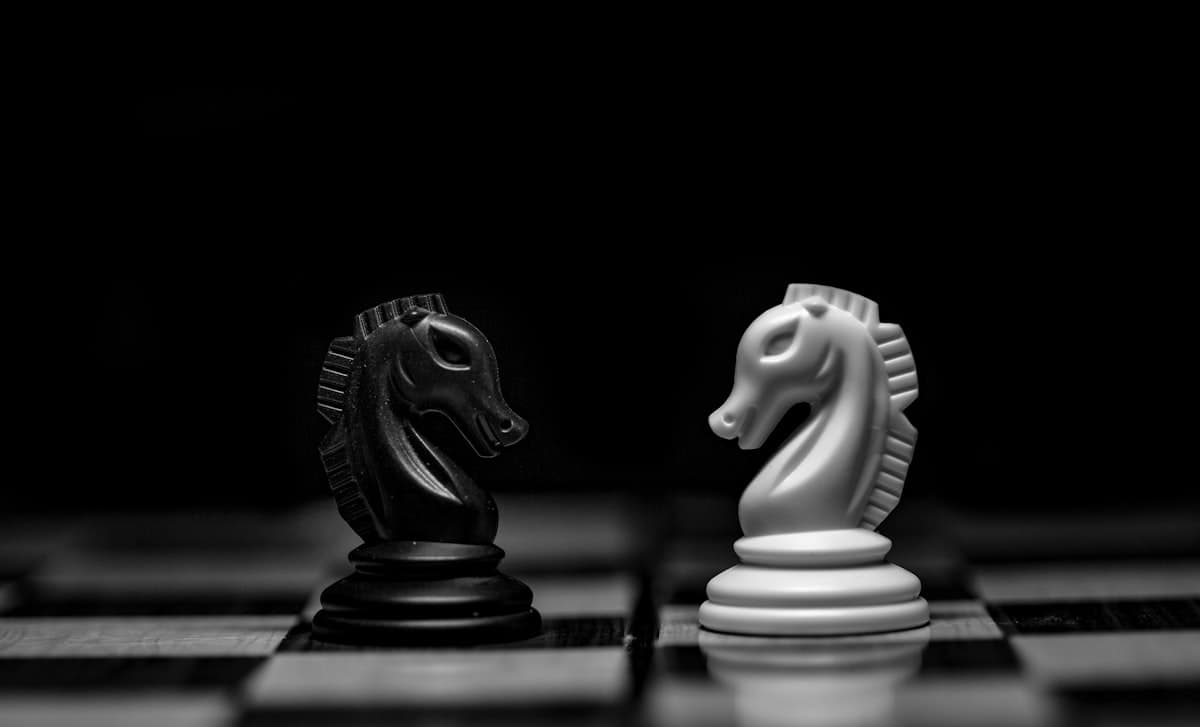
What is opposition in chess? The king duel explained simply
The key concept in king-and-pawn endgames: why the side who doesn't have to move often comes out ahead.
Key takeaway
Whoever does NOT have to move has the opposition: it's usually them who forces the other king to give way.
You've probably heard a chess player say "I have the opposition" in an endgame, as if it were a piece of its own. It's actually one of the most powerful ideas in king-and-pawn endgames, and one of the easiest to understand once you've seen it in action.
The basic idea
Two kings face each other on the same file, rank, or diagonal, separated by exactly one empty square. In this position, the king that does NOT have to move "has the opposition": it's the opponent who must move, and therefore retreat or give way, since neither king is allowed to step any closer to the other (that would be an illegal move).
Why it's so powerful
In chess, you're never allowed to "pass" your turn: if it's your move, you must play something, even if every option is bad for you. This is called zugzwang (German for "compulsion to move"), and opposition is its most common endgame application. The king without the opposition is often forced to let the other one through, which can be enough to win an endgame with a single pawn.
A concrete example
In the diagram above, White's king is already set up in front of its pawn, on e6, and it's Black's move. Black's king has only two legal moves: d8 or f8. It can't stay on e8, and it can't step to d7 or f7, since that would be an illegal move next to the enemy king. Either way, Black gives way: White's king then advances to d6 or f6 and calmly escorts its pawn to promotion.
If it were White to move in this exact same position instead, things would be far trickier: White would have to retreat or maneuver around, giving Black's king a real chance to hold the draw. One single detail, who has to move, completely changes the endgame's outcome.
Direct opposition and distant opposition
The simplest form, called direct opposition, faces the kings one square apart, as in the example above. There's also distant opposition (three or five squares apart on the same file or rank) and diagonal opposition: the principle stays identical, only the distance changes.
How to take the opposition
A practical rule for beginners: count the empty squares between the two kings on the same line. If that number is odd (1, 3, 5...) right before it becomes the opponent's move, you have the opposition. This calculation feels a bit abstract at first, but becomes a reflex after a few king-and-pawn endgames.
Key takeaways
- ✓Opposition pits two kings against each other on the same line, one square apart (or more, at a distance)
- ✓Whoever does NOT have to move has the opposition, and forces the other king to give way
- ✓It's a direct application of zugzwang: being forced to move can become a handicap
- ✓In a tight king-and-pawn endgame, opposition often makes the entire difference between winning and drawing
Check your understanding
In the opposition, which player is in the favorable position?