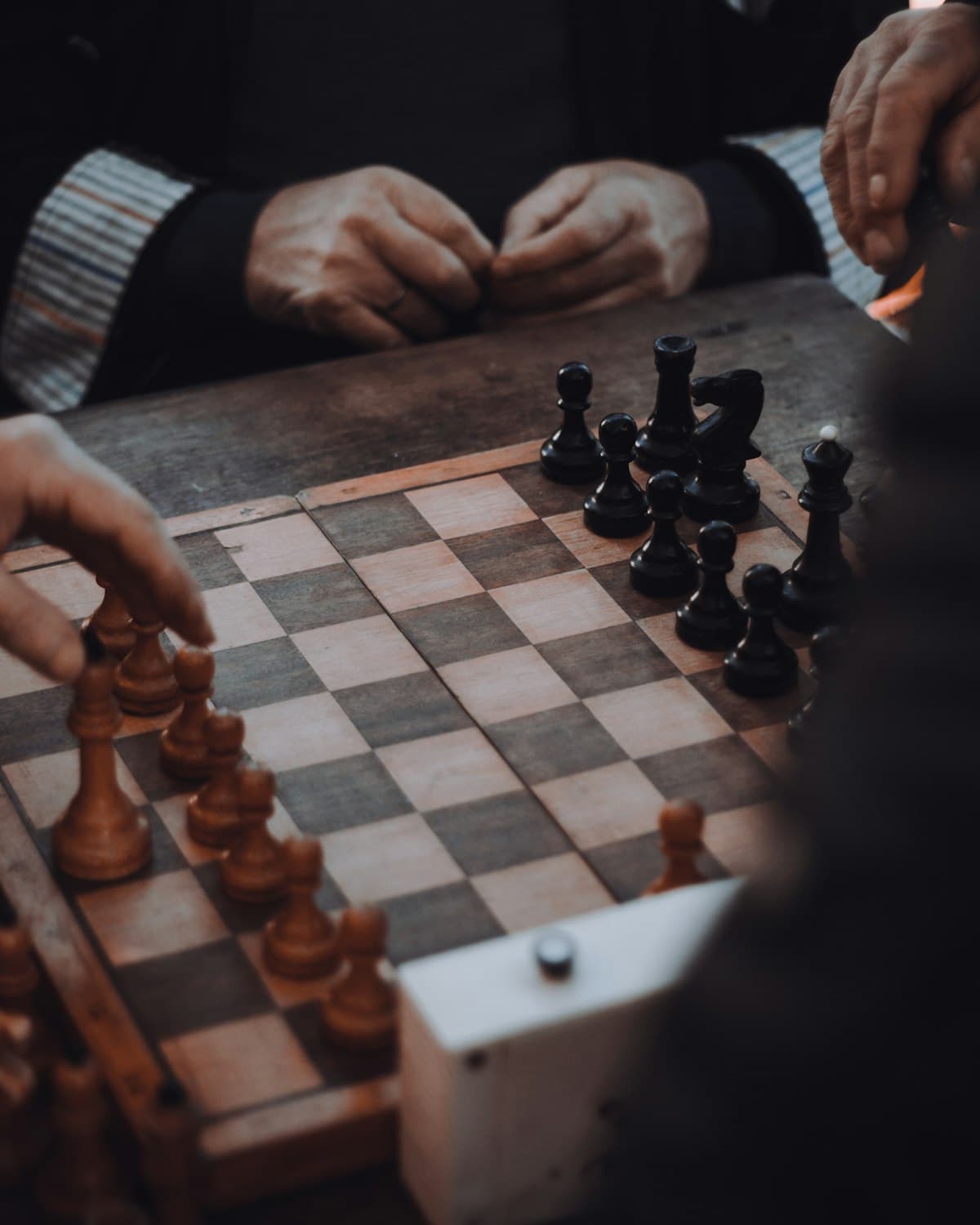
How to evaluate a position and set yourself a plan
Knowing the rules isn't enough: at every moment of a game, you need to know what to do. Here's a simple method for reading a position and choosing a plan.
Key takeaway
Before looking for a move, get in the habit of evaluating the position on four points: material, king safety, pawn structure, space. The plan almost always follows from that evaluation.
Knowing the rules of the game, tactical patterns, and opening principles is essential, but it doesn't tell you what to do at a specific moment in a game. That's where a separate skill comes in: knowing how to evaluate a position in order to draw a coherent plan from it, rather than stringing together isolated moves with no common thread.
The four questions to ask yourself
- ✓Who has more material? Being up a piece or a pawn often changes the whole strategy to adopt
- ✓Which king is safer? An exposed king is a target, and a reason to look for an attack
- ✓Are there any structural weaknesses? A doubled, isolated, or backward pawn is a long-term target
- ✓Who controls more space? Advanced pawns and open files give more room to maneuver
Did you know?
Even the best players in the world spend a large part of their thinking time, in calm positions, not calculating long variations, but simply evaluating the position to decide on a general direction. Precise calculation really only comes into play at critical moments.
Turning an evaluation into a plan
Once the position is evaluated, the plan follows almost naturally. If the opponent has a structural weakness, the plan becomes: attack it, or trade off the pieces that could defend it. If their king is less safe than yours, the plan becomes: open lines against it. A plan in chess doesn't need to be complicated; it mainly needs to be consistent with what the position actually reveals.
A concrete example: the isolated pawn
Look at the diagram above. The white pawn on d4 no longer has any friendly pawn on the neighboring files (c and e) to support it: it's an isolated pawn. The black knight, sitting right in front of it on d5, blocks it completely: this pawn can never advance again without being captured immediately. Black's plan then becomes very clear: maintain this blockade, trade off as many pieces as possible, and calmly pick off this pawn in the endgame, once almost no one is left to defend it.
Key takeaways
- ✓Before choosing a move, evaluate the position: material, king safety, structure, space
- ✓A coherent plan almost always follows from that evaluation
- ✓An opponent's structural weakness, like an isolated pawn, gives a clear long-term target
- ✓Precise calculation matters most at critical moments; evaluation guides the rest of the game
Check your understanding
What four criteria does the article use to evaluate a position?