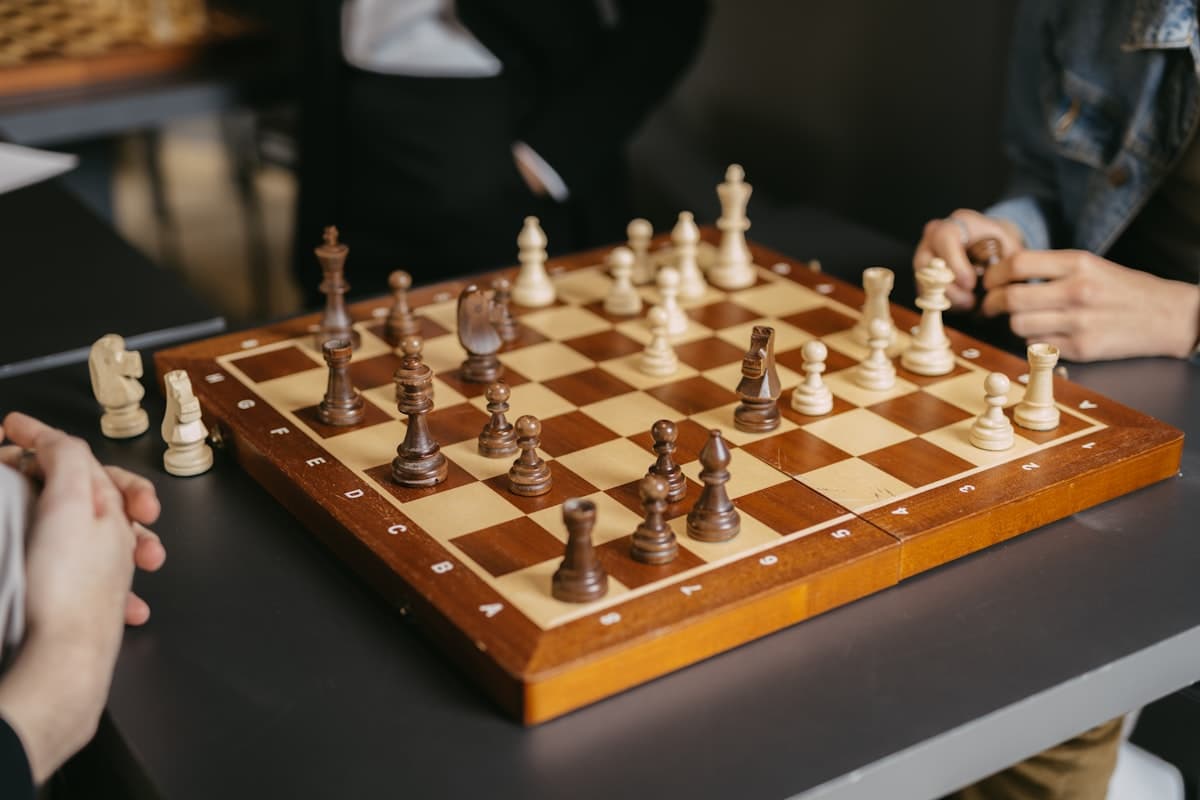
The benefits of chess: what this game really brings to children and adults
Concentration, patience, learning to handle failure, the sheer joy of reasoning: chess offers far more than a simple pastime. Here's what this game can genuinely bring to the whole family.
Key takeaway
Chess builds concentration, patience, and the habit of thinking before acting, in children and adults alike. It's also one of the rare hobbies that naturally brings several generations together around the same activity, with no skill barrier to start.
A game of patience for some, a sport for the mind for others, chess has this rare quality: it crosses generations without losing any of its appeal. A 6-year-old and their grandfather can sit at the same table, follow the same rules, and each find something different in it. Here's what this game genuinely brings, beyond the simple pleasure of playing.
For children: a training ground for the mind
For children, the value of chess goes well beyond learning the rules. Every game requires focusing on a single task for several minutes straight, a skill that doesn't come naturally and has to be trained like a muscle. Having to think through the consequences of a move before playing it builds a form of delayed reasoning, the opposite of an immediate reflex: children learn to pause before acting, a skill that reaches far beyond the chessboard.
- ✓Sustained focus on a single task, without a screen or distractions
- ✓Anticipating consequences before acting, rather than reacting immediately
- ✓Memorizing patterns and structures, useful well beyond chess itself
- ✓Learning to respect shared rules and one's opponent
- ✓Gradually learning to handle the frustration of losing
Losing: the most useful lesson of all
This is probably the most underrated benefit of chess for children: learning to lose. In chess, there's no luck and no external excuse, only moves that could have been played better. Handled with kindness, this repeated encounter with failure builds real resilience: children learn that a loss isn't a catastrophe, just information about what to work on. It's a lesson that serves them well beyond the chessboard, at school and later in life.
For adults: an active break for the mind
For adults, chess plays a different but equally valuable role. Unlike the passive scroll of a screen, a game of chess demands full, undivided attention: for the length of a game, there's simply no room to think about anything else. It's a form of active break, more stimulating than a simple moment of rest, that lets you step completely outside your usual train of thought.
- ✓A complete disconnect from everyday concerns, for the length of a game
- ✓Regular training of memory and concentration, at any age
- ✓A genuine social activity, in a club or online, that builds real connections
- ✓A concrete, measurable sense of progress, rewarding over time
A game with no age limit
What makes chess truly special is that you can start at any age and keep improving your whole life. Unlike many activities where learning slows down over time, an adult beginner can improve just as fast, sometimes faster, than a child, simply by putting in a bit of time each week. There's no such thing as "too late" to start.
Enjoyment, above all
At its core, all these benefits are really just side effects of one thing: the pleasure of solving a problem on your own, move after move. That pleasure is what makes people want to keep playing, keep improving, and explains why chess remains, more than a thousand years after it was invented, one of the most played games in the world.
Key takeaways
- ✓For children: concentration, anticipation, memory, and learning to handle failure
- ✓For adults: an active disconnect, mental training, and social connection
- ✓Chess can be played at any age, with no ceiling on progress tied to starting age
- ✓The real driver is the joy of thinking and improving, not performance
Check your understanding
What benefit of chess does the article highlight across generations?