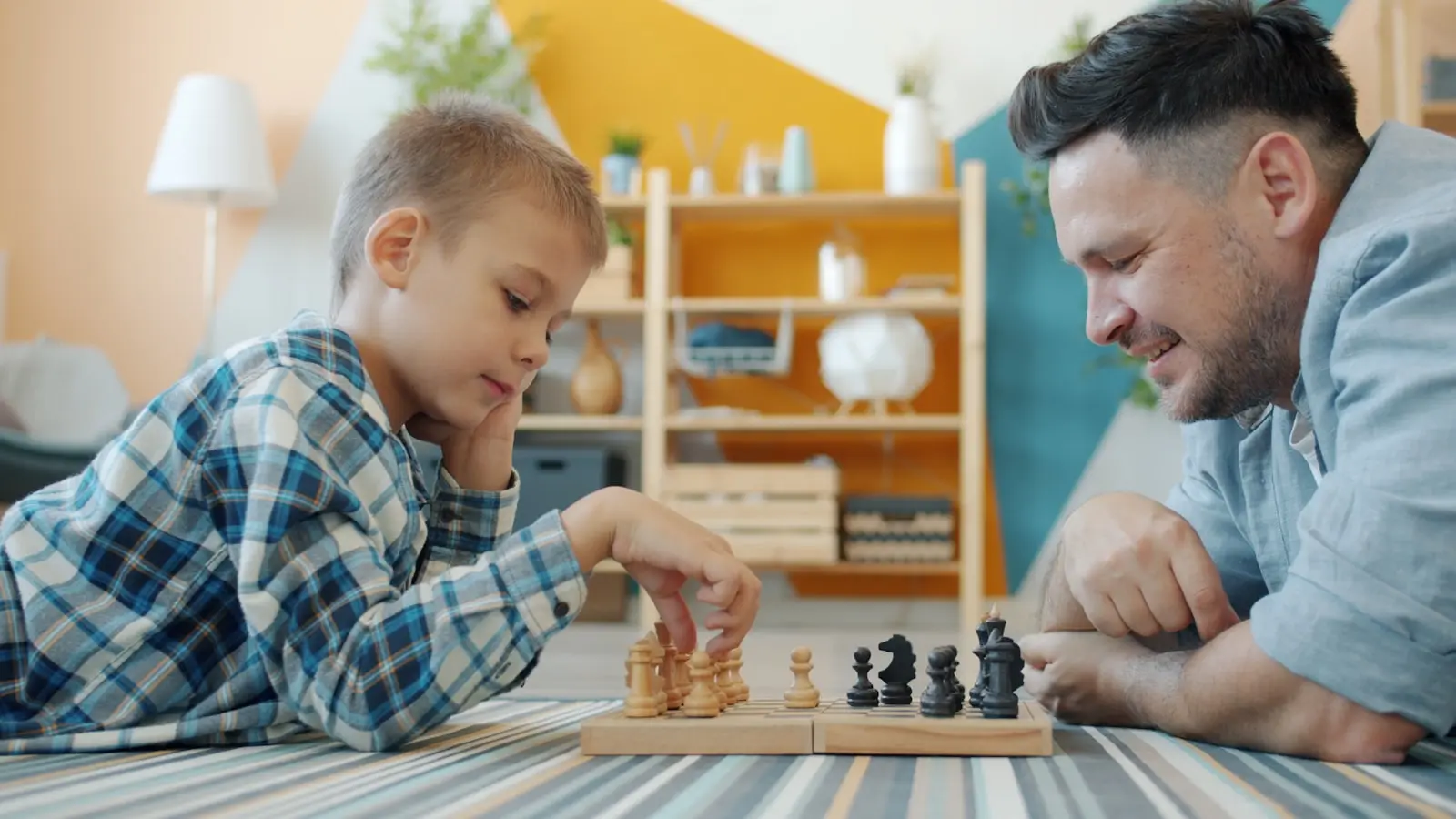
What's the right age to introduce your child to chess?
You don't need to wait until your child can read to discover chess. Here's how to adapt the introduction by age, so it stays fun rather than a chore.
Key takeaway
There's no strict minimum age for discovering chess: as soon as a child can follow a simple instruction and stay focused for a few minutes (often around age 5-6), they can start learning the basic rules. What matters most is adapting the pace and keeping it playful, without any pressure to perform.
"What age can you introduce a child to chess?" It's one of the most common questions from parents discovering the game and wondering if their child is ready. Good news: there's no strict rule, and the right moment depends mostly on the child's temperament, not just their age.
Around age 5-6: the basics of the game
This is generally the age when a child can start understanding how the pieces move, provided they're introduced one at a time rather than all at once. At this age, what matters most isn't performance but the enjoyment of handling the pieces and gradually understanding what each one can do. Some more precocious children can start as early as 4, others will be more receptive at 7 or 8: it's not a race.
Around age 7-9: the logic of the game takes shape
At this age, most children can start grasping more abstract ideas: why develop your pieces, why protect your king, how to spot a piece under attack. This is often when interest in competition (against classmates, in a club, or at a first school tournament) can naturally emerge, without needing to be forced.
Signs a child is ready
- ✓They can follow a simple instruction and stay focused for a few minutes at a stretch
- ✓They show curiosity for rule-based or strategy games in general
- ✓They can accept losing without it being a catastrophe (or can learn to, gradually)
- ✓They enjoy handling objects and organizing them by some logic
What matters more than age: pace and attitude
The biggest risk with a child, whatever their age, is turning chess into a school-like obligation rather than a game. Short sessions (15 to 20 minutes are plenty at first), no pressure over results, and plenty of encouragement even after a loss: that approach is what makes a child want to keep coming back, far more than intensive learning started too early.
Key takeaways
- ✓No strict minimum age: it all depends on the child's attention span, often around age 5-6
- ✓It's better to introduce the rules gradually, one piece at a time
- ✓The goal at first is enjoying the game, not performance
- ✓Short, regular sessions beat occasional intensive learning
Check your understanding
According to the article, around what age can a child usually start learning the basic rules?