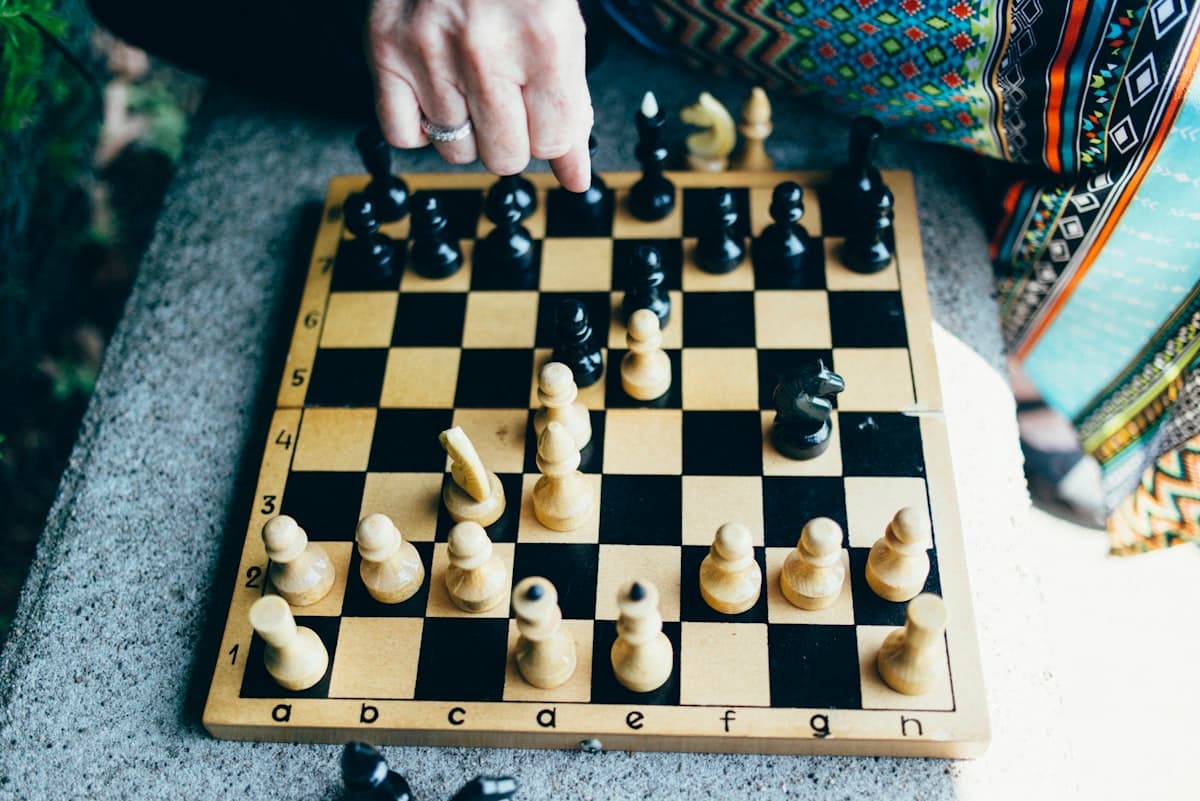
How chess pieces move
The absolute starting point: what each piece can and cannot do on the board.
Key takeaway
Every piece has its own rules: learning them by heart is the one unavoidable step.
Picture the chessboard as a tiny kingdom with 6 kinds of inhabitants, each with their own way of getting around. Once you know their rules, you'll never forget them again!
The pawn: the little soldier that never retreats
The pawn moves straight ahead, one square at a time (two on its very first move), but it can only capture diagonally. Once it has moved forward, it can never go back: it's the only inhabitant of the kingdom that never retreats! And if it manages to reach the far end of the board, a big reward awaits: it gets promoted into a more powerful piece, almost always a queen.
Did you know?
A pawn that reaches the last rank can even be promoted into a second queen! Nothing stops you from having two queens on the board at once, a great way to surprise an opponent who isn't expecting it.
The rook: it charges in a straight line
The rook moves like an arrow: straight ahead, horizontally or vertically, as far as it wants, as long as nothing blocks its path. It can never jump over another piece. On a wide-open file or rank, it becomes fearsome.
The bishop: the traveler of the diagonals
The bishop glides diagonally, as far as it wants. One important detail: each bishop always stays on the same color square it started on! A bishop that begins on a light square will never set foot on a dark one, even after a hundred moves. That's why players talk about the "light-squared bishop" and the "dark-squared bishop".
The knight: the only one that knows how to jump
The knight moves in an "L" shape: two squares in one direction, then one square to the side. A little confusing at first, but here's a trick so you never get it wrong again: trace the letter L around it in any direction, and you'll find every square it can reach. Best of all, it's the only piece in the game that can jump over others, just like a real horse leaping over an obstacle. Look at the diagram below: even surrounded by its own pieces on the very first move, the knight can jump straight to a3 or c3!
The queen: the most powerful piece in the kingdom
The queen combines the powers of the rook and the bishop at once: she moves in a straight line or diagonally, as far as she wants. She's the most powerful piece on the whole board, which is exactly why you shouldn't send her out alone too early: plain little pawns could be enough to chase her away.
The king: precious, but fragile
The king only moves one square at a time, in any direction. He's precious but fragile: he can never move to a square watched by an enemy piece, that's an illegal move, not just a bad idea. The whole game revolves around protecting him. And unlike every other piece, he's never actually captured: he's put in "checkmate", meaning he's trapped with no way to escape. The game ends immediately.
Quick recap
- ✓Pawn: moves straight ahead, captures diagonally, never retreats
- ✓Rook: straight line, as far as it wants
- ✓Bishop: diagonal, always on the same color square
- ✓Knight: "L" shape, the only piece that can jump over others
- ✓Queen: rook and bishop combined, the most powerful of all
- ✓King: one square at a time, never onto a watched square
Now that you know everyone in the kingdom, there's only one thing left to do: watch them play together on a real board!
Check your understanding
Which is the only piece that can jump over other pieces?